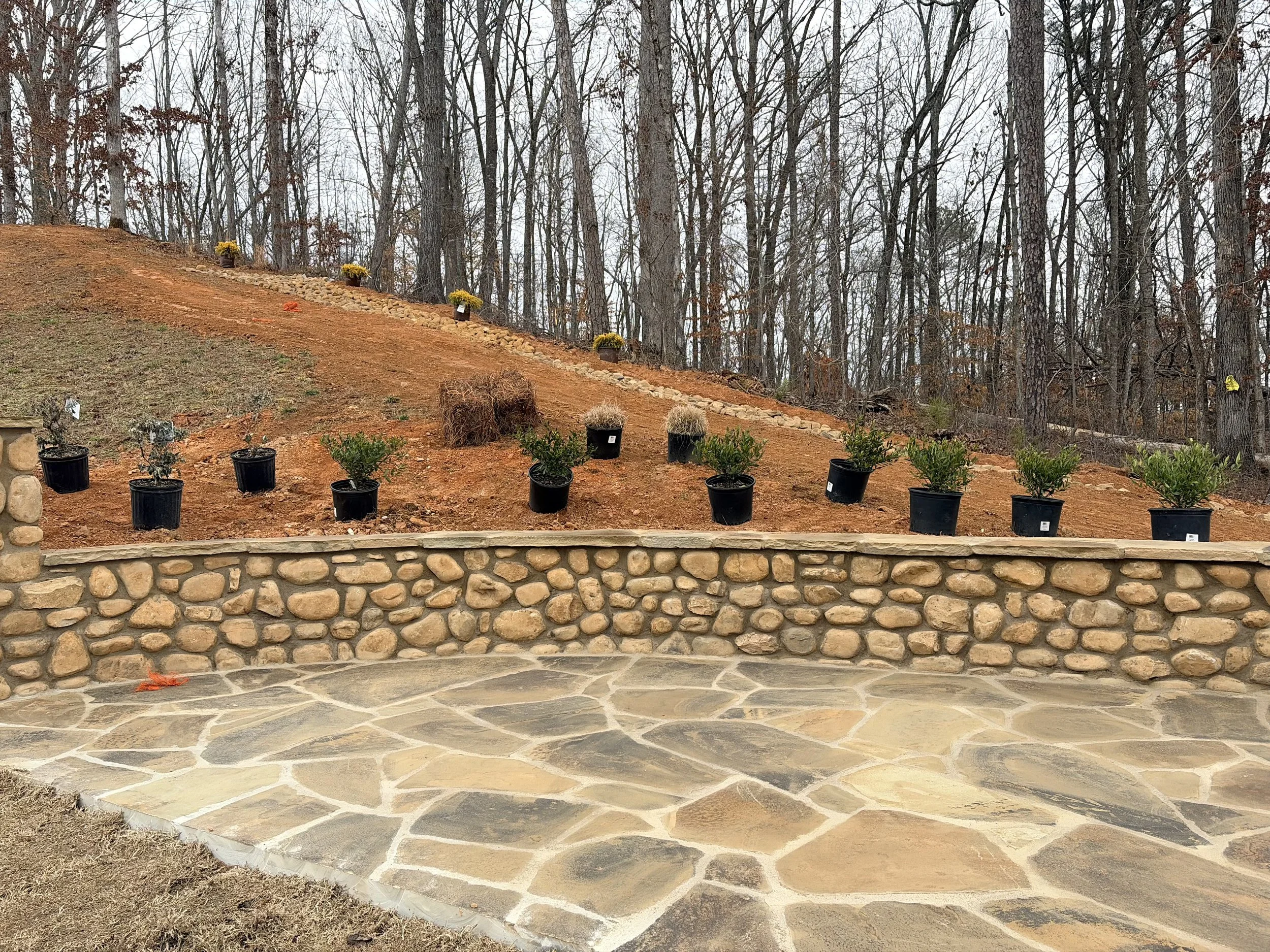
Stone is how a slope becomes usable. A masonry contractor in Woodstock, GA spends most of a year turning ground that drops away from the house into terraces, seating, and steps that a family actually stands on, and the work changes how much of a property is available to use.
O’Neill Landscape Group started in 2007 during the Great Recession, not as a business plan but as a necessity, when founder Andrew O’Neill, a University of Georgia-trained landscape architect, set out on his own.
North Georgia lots tend to come with grade, and grade is the problem masonry solves. Here is what that work involves and what it tends to make possible on a residential property.
Related: Retaining Wall Installation in Woodstock, GA: How Much Flat Yard a Wall Buys You
What Does Masonry Work Involve in a Residential Landscape?
Residential masonry work covers retaining and seating walls, stone steps, terraces, outdoor fireplaces, and the stonework around kitchens and patios, built in block, natural stone, or brick depending on the setting.
On a sloped Cherokee County lot the retaining work usually comes first, because it creates the level ground that everything else sits on.
The steps and seat walls then connect those levels into a yard that works as one space.
How Does a Seat Wall Change How a Patio Gets Used?
A seat wall gives a patio an edge and a permanent place to sit without furniture, which quietly doubles how many people the space holds. It also defines the boundary between the patio and the planting.
Built at the right height with a comfortable cap, it reads as part of the architecture rather than as a low wall someone perches on.
Placed around a fire pit, it turns the patio into the place guests gather without anyone dragging chairs across the stone.
What Decides Between Natural Stone and Manufactured Block?
The look of the house, the scale of the wall, and the way the material weathers decide between natural stone and manufactured block.
Natural stone, such as crab orchard, varies piece to piece and settles into a planted slope as it ages.
The manufactured block gives a consistent line and a predictable face, which suits long runs and geometric terraces. Both are structurally sound when built correctly, so the choice is largely about how the finished yard should read.
Related: Outdoor Stair Builders in Woodstock, GA: Making the Slope Part of the Yard
How Are Stone Steps Laid Out on a Slope?
Stone steps are laid out by setting riser height and tread depth from the grade, then holding both consistent along the whole run, because an uneven step is the one people catch a toe on.
A comfortable outdoor step is shallower and deeper than an indoor one.
Laying out the full run before anything is set lets the steps land where the path naturally wants to go rather than where the slope happens to allow.
Why Does Drainage Matter Behind a Stone Wall?
Drainage matters because water collecting behind a wall adds load the structure was not designed to carry, and Georgia clay holds that water well after a storm has passed. Drainage behind the wall is what keeps it standing plumb.
The visible stone is the part people judge, and the hidden half is the part that decides the lifespan.
A wall built with drainage detailed from the start protects the property from shifting soil rather than adding to the problem.
How Does Stonework Tie Into the Rest of a Landscape?
Walls and steps set the levels that planting, lighting, and paving then work to, so they are drawn as part of the whole plan rather than priced as a separate item.
A terrace built without knowing where the beds and the path will go tends to end up with an awkward strip of leftover ground along one edge.
As a design-and-build firm, we draw the stonework and the landscape around it together.
Opening Up a Sloped Yard With a Masonry Contractor in Woodstock
Most yards around here have more usable ground in them than they appear to. A terrace cut into a slope, a few stone steps, and a seat wall at the edge turn an unused bank into the part of the property a family spends evenings on.
O’Neill Landscape Group designs and builds retaining walls, seating walls, stairs, and fire features for homes across Woodstock, Holly Springs, Canton, Ball Ground, Roswell, and Alpharetta.
Schedule your masonry consultation with O’Neill Landscape Group.
In Summary
How tall can a retaining wall be built in Woodstock, GA before it needs engineering?
Retaining wall height thresholds vary by jurisdiction, and walls carrying a driveway or structure above them typically require review regardless of height. Confirming it during design keeps permitting off the build schedule.
Do stone walls need sealing in a Georgia climate?
Most stone walls in Georgia do not need sealing. Sealing is occasionally used on a specific stone for appearance rather than protection, and a correctly built and drained wall holds up without it.
Can masonry work be phased across more than one season?
Masonry work is commonly phased across seasons, and terracing a slope in stages works well on larger lots. O’Neill Landscape Group plans the grading and drainage for the whole area from the start so later phases connect to the earlier ones properly.
How long does a terrace and step project usually take on site?
Most residential terrace and step projects take a few weeks on site once excavation begins, with the base and drainage work taking longer than the stone setting. Weather on a clay site is the usual variable.
Related: French Drain Installation in Woodstock, GA: Designing Where the Water Goes